
Written by John, Energy Watch UK
Last updated: 24 August 2026
Author: John – Your Local Energy Watch UK Expert
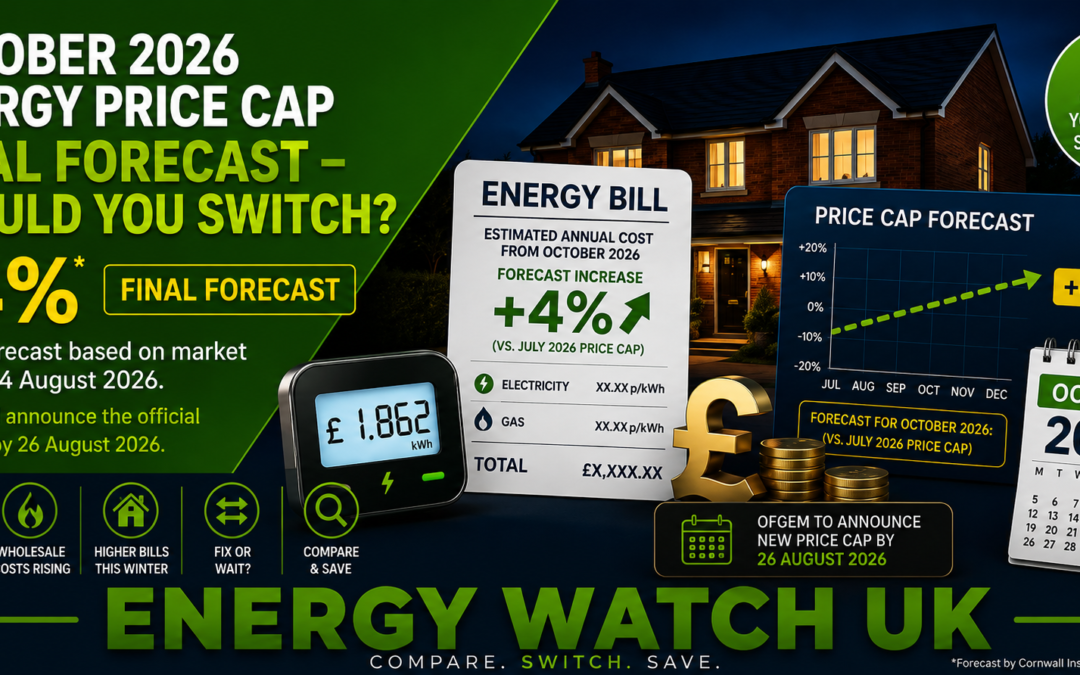
UK households could face another increase in energy costs this autumn, with the latest forecast suggesting the Ofgem energy price cap could rise again from 1 October 2026.
With winter approaching, many households are now asking whether they should remain on a standard variable tariff, move to a fixed tariff or compare other energy deals before October.
The important point is that the October price cap has not yet been officially confirmed by Ofgem.
However, the final industry forecast ahead of the announcement now gives households a much clearer indication of what could happen.
At Energy Watch UK, we help households compare energy tariffs and understand their switching options before making a decision.
What Is the Latest October 2026 Energy Price Cap Forecast?
The latest forecast from energy consultancy Cornwall Insight predicts that the price cap could rise by approximately 4% from October.
Using Ofgem’s newer typical household consumption figures, the forecast is approximately £1,729 a year for a typical dual-fuel household paying by Direct Debit.
This compares with a current equivalent headline figure of approximately £1,663 using the same newer consumption assumptions.
That would represent an increase of around £66 a year for a household using the assumed typical amount of gas and electricity.
However, these figures are still forecasts.
Ofgem is expected to publish the official price cap applying from 1 October to 31 December 2026 by 26 August.
Why Do Some Energy Price Cap Figures Look Different?
You may have seen different figures reported for the current and predicted price caps.
This is because Ofgem changed the Typical Domestic Consumption Values used to illustrate what a typical household might pay.
The newer figures assume lower annual household energy consumption than the previous figures.
Using the previous consumption assumptions, the current July price cap is commonly quoted as £1,862.
Using those previous consumption levels, Cornwall Insight’s October forecast is approximately £1,941.
Using Ofgem’s newer consumption assumptions, the forecast is approximately £1,729.
This does not mean households have suddenly received a large reduction in their energy rates.
The price cap controls the maximum rates suppliers can charge customers on standard variable tariffs rather than setting a maximum total annual energy bill.
Your actual bill depends on how much gas and electricity you use.
For more information about typical household costs, read:
Average Gas and Electricity Bill UK 2026
Why Could Energy Prices Rise Again in October?
Wholesale energy prices remain one of the biggest factors affecting household energy tariffs.
Global gas markets have experienced continued volatility during 2026, with international events putting pressure on wholesale prices.
Higher wholesale costs eventually feed through into the amount suppliers are allowed to charge customers under the price cap.
This means that even though measures have been announced to reduce some electricity costs, higher wholesale energy prices could outweigh some of those savings.
What Could Electricity and Gas Cost From October?
The final forecast indicates that average electricity and gas costs could remain elevated going into winter.
The precise rates will not be known until Ofgem publishes the official October price cap.
It is also important to remember that energy rates vary depending on factors including:
-
Where you live
-
How you pay
-
Your meter type
-
Your tariff
-
Your energy supplier
This means the national headline price cap figure should never be treated as the exact amount your household will pay.
Does the Energy Price Cap Limit My Total Bill?
No.
This is one of the biggest misunderstandings surrounding the Ofgem energy price cap.
There is no £1,729 maximum household energy bill.
The headline figure is an illustration based on assumed typical consumption.
If your household uses more energy, you can pay considerably more.
If you use less energy, you could pay less.
The price cap primarily limits the rates suppliers can charge customers on default tariffs for each unit of energy, together with standing charges.
Should You Switch Energy Tariff Before October?
This is the question many households should be considering.
If you are currently on a standard variable tariff, you do not necessarily have to wait for the October price cap to begin comparing alternatives.
Fixed energy tariffs are available from a range of suppliers.
Whether switching makes sense depends on your individual circumstances and the tariffs available to you.
Before switching, compare:
-
Electricity unit rates
-
Gas unit rates
-
Electricity standing charges
-
Gas standing charges
-
Estimated annual cost
-
Length of the tariff
-
Exit fees
-
Payment method
-
Your actual annual consumption
Do not choose a tariff based solely on the headline estimated annual cost.
Energy Price Cap or Fixed Tariff: Which Is Better?
There is no single answer that applies to every household.
A fixed tariff provides greater certainty over your unit rates for a specified period.
A standard variable tariff can change when Ofgem changes the price cap.
If energy prices fall significantly, remaining variable could potentially allow you to benefit from future reductions.
If energy prices rise, a competitive fixed tariff could potentially protect you from some of those increases.
The decision should therefore be based on the actual tariff available to you rather than trying to predict exactly what energy markets will do.
Read our recent comparison:
Energy Price Cap or Fixed Tariff: Which Is Cheaper?
Should You Fix Your Energy Tariff Now?
If you have found a competitive fixed tariff, it may be worth comparing it against what you currently pay and the latest October price cap forecast.
But fixing is not automatically the right decision.
Check:
-
How the fixed unit rates compare with your current rates
-
The standing charges
-
How long the tariff is fixed
-
Whether exit fees apply
-
Your household’s actual energy consumption
-
Whether you value certainty over flexibility
For a more detailed explanation, read:
Should You Fix Your Energy Tariff Before October 2026?
What About No Standing Charge Energy Tariffs?
Standing charges have become an increasingly important consideration when households compare tariffs.
Some consumers may be interested in tariffs that reduce or remove the traditional daily standing charge.
However, a tariff with no standing charge is not automatically cheaper.
The unit rates charged for the energy you actually use could be different, so the complete annual cost needs to be compared.
This can be particularly important for high-usage households.
Read our recent guide:
No Standing Charge Energy Tariffs: Are They Worth It in 2026?
Could Your Energy Bill Rise This Winter?
Potentially.
October marks the beginning of a period when many households start using considerably more gas and electricity.
Heating comes back on, daylight hours shorten and households typically spend more time indoors.
Therefore, even relatively small changes in energy rates can become more noticeable during autumn and winter.
Your total bill could also increase simply because you consume more energy, even if your tariff rates remain unchanged.
Why Comparing Energy Tariffs Matters
Remaining with the same energy supplier may be convenient, but it does not necessarily mean you are receiving the best available tariff for your circumstances.
The energy market continues to change.
New fixed deals can appear.
Existing deals can disappear.
Suppliers can change their tariff offerings.
Your own energy consumption can also change.
Regularly reviewing your energy tariff allows you to understand how your current deal compares with alternatives.
Does Where You Live Affect Energy Prices?
Yes.
Energy unit rates and standing charges can vary by region.
This means households in different parts of Great Britain may pay slightly different rates even when covered by the same national price cap.
Energy Watch UK helps customers compare energy options across:
-
Cornwall
-
Devon
-
Bristol
-
Bath
-
Bournemouth
-
Cardiff
-
Gloucestershire
-
The South West
-
Other areas across the UK
When Will Ofgem Announce the October Price Cap?
Ofgem is due to publish the official price cap covering 1 October to 31 December 2026 by 26 August.
Once the official figures are released, households will be able to compare confirmed October rates against fixed tariffs currently available.
Energy Watch UK will update customers with the latest information once the official rates are confirmed.
Frequently Asked Questions
Is the October 2026 energy price cap £1,729?
Not yet. Approximately £1,729 is the final Cornwall Insight forecast using Ofgem’s newer typical household consumption assumptions. Ofgem still needs to officially confirm the October price cap.
When will the October 2026 energy price cap be announced?
Ofgem is due to publish the price cap applying from 1 October to 31 December 2026 by 26 August.
Is £1,729 the maximum I can pay for energy?
No. The headline price cap figure illustrates what a household using an assumed typical amount of gas and electricity might pay. Your actual bill depends on your consumption.
Should I switch before October?
It depends on your current tariff and the alternatives available. Comparing current fixed and variable tariffs can help you understand whether switching could provide better value or greater price certainty.
Is a fixed energy tariff always cheaper?
No. Fixed tariffs can provide certainty but are not guaranteed to be cheaper. Compare unit rates, standing charges, exit fees and your estimated annual cost.
Do energy tariffs vary depending on where I live?
Yes. Unit rates and standing charges can vary by region, payment method and meter type.
For more answers about comparing and switching energy suppliers:
Compare Energy Tariffs With Energy Watch UK
With energy prices forecast to rise again from October, now is a sensible time to understand exactly what you are paying.
Do not assume your existing tariff is automatically your best option.
Compare the complete tariff, including unit rates, standing charges, contract length and exit fees.
Energy Watch UK helps households understand their energy options and compare available tariffs.
Check us out on Trustpilot.