
Written by John, Energy Watch UK
Last updated: 25 August 2026
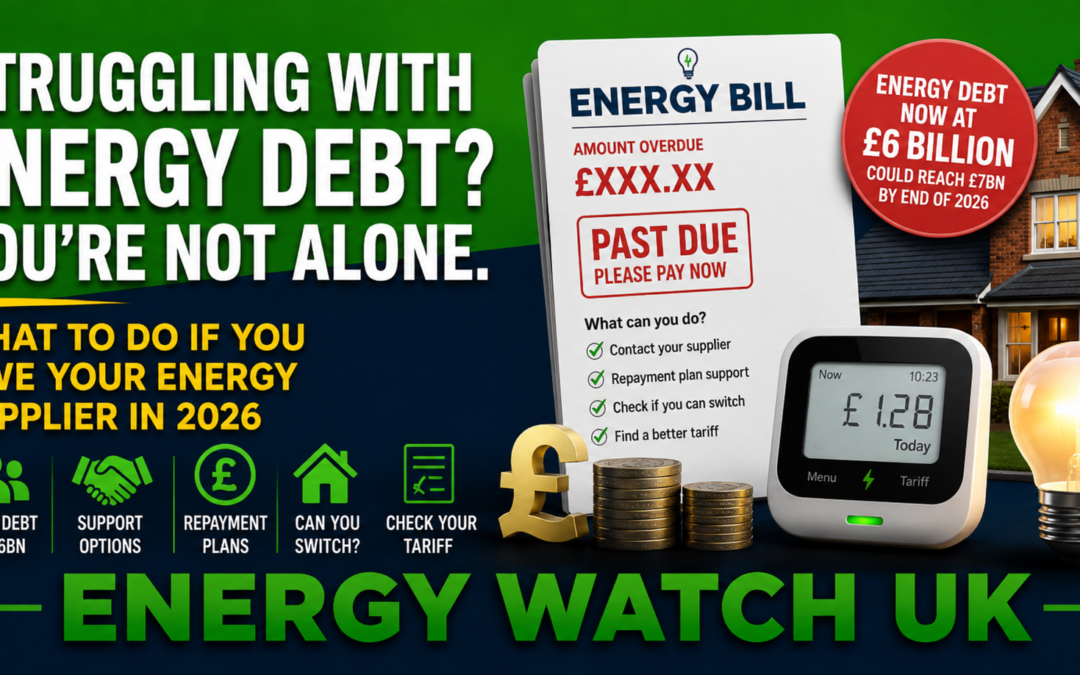
Energy debt in Great Britain has reached a record level, with households now owing around £6 billion to energy suppliers.
The figure has increased by approximately £500 million over the past year, and industry estimates suggest total household energy debt could approach £7 billion by the end of 2026 if current pressures continue.
With energy bills remaining high and further uncertainty heading into winter, more households may find themselves struggling to keep up with gas and electricity payments.
If you owe your energy supplier money, the most important thing is not to ignore it. There are steps you can take, and being in energy debt does not necessarily mean you cannot change tariff or supplier.
At Energy Watch UK, we explain what happens if you fall behind with your energy bills, what support may be available and when energy debt can affect your ability to switch.
Why Is UK Energy Debt So High?
Household finances have been under pressure for several years, while gas and electricity prices remain considerably higher than they were before the energy crisis.
Energy UK has previously warned that energy debt is at record levels, while rising wholesale energy costs continue to put pressure on household bills.
This comes at a time when many consumers are already questioning whether their current bills are unusually high.
If you are unsure how your costs compare, read our latest guide: Average Gas and Electricity Bill UK 2026.
The important thing to remember is that the headline annual energy bill figures are only estimates based on assumed consumption. Your actual bill depends on your tariff, unit rates, standing charges and how much energy your household uses.
What Should I Do If I Can’t Pay My Energy Bill?
Contact your energy supplier as soon as you realise you may struggle to make a payment.
Waiting until several payments have been missed can make the situation more difficult.
Explain your circumstances and ask what options are available. Depending on your situation, your supplier may be able to discuss an affordable repayment arrangement or other forms of support.
When agreeing a repayment plan, make sure the amount is genuinely affordable alongside your ongoing energy use and other essential household costs.
Do not simply agree to a repayment figure you already know you will struggle to maintain.
Should I Cancel My Energy Direct Debit?
Cancelling your Direct Debit without speaking to your supplier first is not normally the best first step.
If your payments have become unaffordable, contact your supplier and ask them to review the amount.
It is also worth checking whether the Direct Debit reflects your actual energy consumption and current account balance.
Take fresh meter readings where possible and compare them with your latest bill.
If your account has been based on estimated readings, your balance may not accurately reflect the energy you have actually used.
Can I Switch Energy Supplier If I Owe Money?
Sometimes.
Whether energy debt prevents you from switching depends on your circumstances and how old the unpaid balance is.
For customers paying by credit, you may still be able to switch if the unpaid bill was sent less than 28 days ago. Older outstanding debt can potentially result in your existing supplier blocking the switch until the balance is resolved.
Different rules can apply to customers using prepayment meters.
This is why you should not automatically assume that owing your supplier money means you are permanently stuck on your existing tariff.
Check your position first.
If your debt prevents you from moving immediately, dealing with the outstanding balance could eventually reopen your switching options.
Can I Switch With Prepayment Meter Debt?
There are specific rules for prepayment customers.
Under the Debt Assignment Protocol, some prepayment customers can transfer qualifying debt to a new supplier when switching.
Current consumer guidance states that customers owing no more than £500 for gas and no more than £500 for electricity may be able to switch, provided the new supplier agrees to take on the debt.
The rules can vary depending on your circumstances, so check directly before starting a switch.
Does Switching Supplier Clear Energy Debt?
No.
This is an important distinction.
Changing energy supplier does not make money owed to your previous supplier disappear.
Any outstanding balance still needs to be dealt with.
However, once you are eligible to switch, comparing tariffs may help reduce your ongoing energy costs if a more suitable deal is available.
The aim should therefore be to tackle the existing debt while also making sure you are not unnecessarily overpaying for the energy you use in future.
Could My Energy Supply Be Disconnected?
Disconnection because of household energy debt is possible in certain circumstances, but it is rare.
Suppliers are expected to follow strict procedures and should work with customers to find a suitable repayment solution.
A supplier may consider other measures, including moving an eligible household onto prepayment, but additional protections apply and suppliers must consider whether prepayment is safe and practical for the household.
If you have received a warning about disconnection or forced prepayment, contact your supplier immediately rather than ignoring the correspondence.
Check Whether Your Current Tariff Is Making Things Worse
If you are struggling with bills, it is worth understanding exactly what you are paying.
Check:
- Your electricity unit rate
- Your gas unit rate
- Your daily standing charges
- Your annual electricity consumption in kWh
- Your annual gas consumption in kWh
- Whether your tariff is fixed or variable
- Whether an exit fee applies
- Your current account balance
- Whether your bills are based on actual or estimated readings
Standing charges can make up a significant part of some households’ bills, particularly for lower-energy users.
We recently looked at this in No Standing Charge Energy Tariffs: Are They Worth It in 2026?
Do not compare energy deals using only the estimated monthly Direct Debit. Compare the tariff rates and calculate the cost using your own annual consumption wherever possible.
What About the October 2026 Energy Price Cap?
The energy market is approaching another important change, with the next Ofgem price cap applying from 1 October 2026.
Wholesale market movements have increased concerns that bills could rise again heading into winter.
For the latest position, see our October Energy Price Cap 2026: Full and Final Forecast.
You can also read our earlier analysis in Energy Price Cap Forecast October 2026: Energy Bills Could Rise Again to see how expectations have developed.
Remember that the price cap does not cap your total bill. It limits the rates suppliers can charge customers on applicable standard variable tariffs.
Use more energy and you will still pay more.
Should You Fix Your Energy Tariff?
There is no single answer that is right for every household.
A fixed tariff can provide greater certainty over your unit rates for a set period, while a variable tariff can allow you to benefit if capped rates fall.
When comparing a fixed tariff, look at the full deal rather than simply the advertised estimated annual cost.
Check the unit rates, standing charges, contract length and exit fees.
Most importantly, compare the tariff using your own annual gas and electricity consumption.
What If I Am Already Struggling With Energy Debt?
Start with the problem that needs dealing with first.
Contact your supplier and discuss the outstanding balance.
Make sure your meter readings and bills are accurate.
Ask about an affordable repayment arrangement where necessary.
Then review the tariff you are currently paying.
Existing debt and future energy costs are two separate issues. Resolving the first does not mean you should ignore the second.
Once you are able to switch, comparing available tariffs could help you understand whether your existing supplier remains competitive.
Compare Energy Tariffs With Energy Watch UK
Energy prices can vary considerably depending on your location, consumption, payment method and the tariffs currently available.
Energy Watch UK helps households compare gas and electricity tariffs and understand their options.
If you are currently in energy debt, speak to your existing supplier about the outstanding balance first.
If you are eligible to switch, comparing the wider market can then help you see whether another tariff or supplier could offer better value for your future energy use.
Visit our Home page to start comparing energy tariffs.
You can also view Areas We Cover, read our FAQs, learn more About Us, or see what customers say about Energy Watch UK on Trustpilot.
Frequently Asked Questions
Can I change energy supplier if I owe money?
Potentially. Whether you can switch depends on factors including how long the debt has been outstanding and your payment method. Some newer unpaid balances may not prevent a switch, while older debt can potentially result in the switch being blocked.
Can I switch supplier with prepayment meter debt?
Potentially. Under the Debt Assignment Protocol, eligible prepayment customers with qualifying debt may be able to transfer that debt to a new supplier. Check your eligibility before applying.
Will changing energy supplier wipe out my debt?
No. Switching supplier does not cancel money already owed to your previous energy company.
What should I do if I cannot afford my energy bill?
Contact your supplier as early as possible. Explain the situation and ask about affordable repayment options and any support that may be available.
Can my energy supplier disconnect me for debt?
Disconnection can occur in certain circumstances but is rare for domestic customers. Suppliers must follow rules and procedures and should explore repayment options first.
Should I cancel my Direct Debit if my energy bill is too high?
Speak to your supplier before simply cancelling it. Ask them to review the payment against your actual consumption, meter readings and account balance.
Can comparing energy tariffs help if I am in debt?
Comparison will not remove existing debt, but checking your ongoing tariff can help establish whether you could pay less for future energy once you are eligible to switch.
Check Your Energy Tariff Today
Record energy debt is a reminder of just how important it is to understand what you are paying for gas and electricity.
If you are struggling with an outstanding balance, contact your supplier and deal with the debt first.
Then check your current tariff.
If you are able to switch, compare gas and electricity tariffs with Energy Watch UK and see what options are available for your home.
Author: Energy Watch UK
Last updated: 25 August 2026
Energy Watch UK provides energy comparison information. If you are experiencing financial difficulty or struggling with energy debt, contact your energy supplier and seek appropriate independent debt advice.