
Written by John, Energy Watch UK
Last updated: 22 August 2026
Updated: 22 August 2026
Energy bills remain one of the biggest household expenses in the UK, and one question comes up again and again:
Am I paying too much for gas and electricity?
One of the easiest places to start is by comparing your bill with typical household energy costs.
But there is an important catch.
There isn’t one energy bill that can genuinely be called “average” for everybody.
How much you pay depends on how much energy you use, where you live, your tariff, payment method, standing charges and the unit rates you’re being charged.
So, what does an average UK energy bill look like in 2026, and how does yours compare?
Energy Watch UK explains.
What Is the Average UK Energy Bill in 2026?
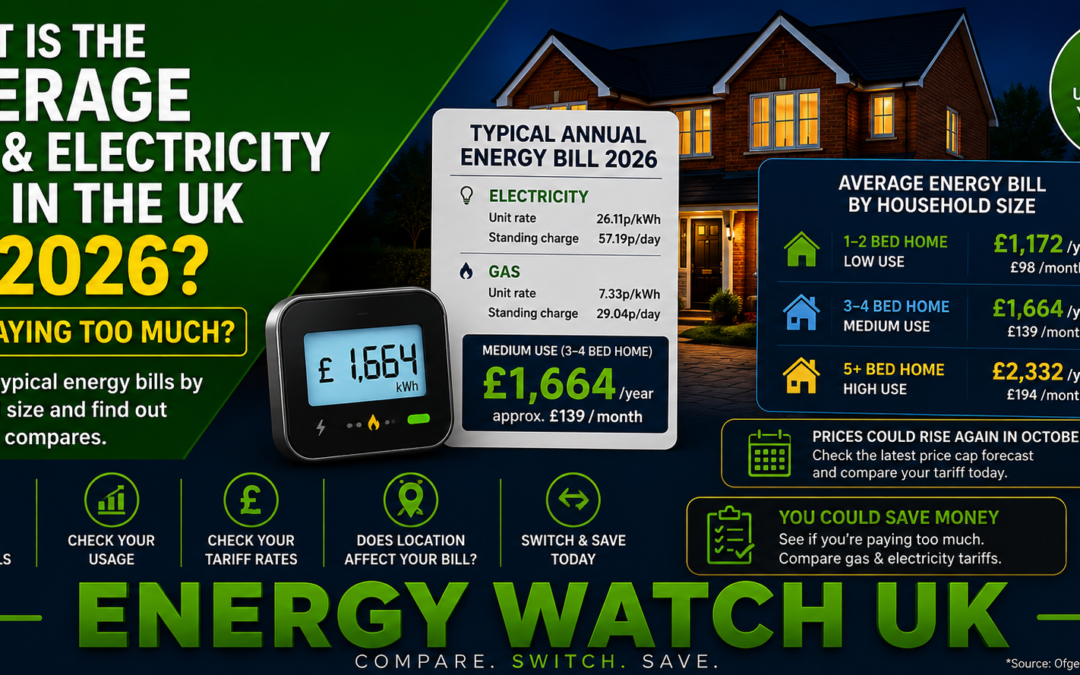
For the current July to September 2026 period, a medium-use dual-fuel household paying by Direct Debit on price-capped rates is commonly illustrated at around £1,663 a year using the newer typical consumption benchmark.
However, you may also see a higher headline price-cap figure of £1,862. This is because Ofgem changed the typical domestic consumption values used for comparisons during 2026.
The important point is this:
Neither figure is a maximum bill.
Your actual bill depends on how much gas and electricity you use and the tariff rates that apply to your home.
Average Energy Bill by Household Size
Using current average July 2026 rates and typical consumption estimates, household costs can look approximately like this:
Low energy use — typically a 1–2 bedroom home
Gas: around 6,000 kWh per year
Electricity: around 1,600 kWh per year
Estimated annual bill: £1,172
Estimated monthly average: £98
Medium energy use — typically a 3–4 bedroom home
Gas: around 9,500 kWh per year
Electricity: around 2,500 kWh per year
Estimated annual bill: £1,664
Estimated monthly average: £139
High energy use — typically a 5+ bedroom home
Gas: around 14,000 kWh per year
Electricity: around 3,800 kWh per year
Estimated annual bill: £2,332
Estimated monthly average: £194
These figures are illustrations rather than targets.
A smaller home can use more energy than a larger home, while an energy-efficient larger property could potentially use less.
What Is the Average Electricity Bill in the UK?
Using medium annual consumption of approximately 2,500 kWh, electricity usage at current average July rates costs roughly £653 per year before the electricity standing charge is added.
The average Direct Debit electricity standing charge is currently around 57.19p per day.
Over a full year, that’s more than £200 in standing charges before considering the electricity you actually use.
This is one reason it’s important to look at both the unit rate and standing charge when comparing tariffs.
If you’d like to understand alternative tariff structures, read No Standing Charge Energy Tariffs: Are They Worth It in 2026?
What Is the Average Gas Bill in the UK?
Using medium annual gas consumption of approximately 9,500 kWh, gas usage at current average July rates costs roughly £696 per year before the gas standing charge is included.
The average Direct Debit gas standing charge is currently around 29.04p per day.
Again, your actual cost could be considerably higher or lower depending on your consumption and tariff.
What Are the Current Average Energy Rates?
For Direct Debit customers under the July to September 2026 price-cap period, average rates are approximately:
Electricity
Unit rate: 26.11p per kWh
Standing charge: 57.19p per day
Gas
Unit rate: 7.33p per kWh
Standing charge: 29.04p per day
Rates can vary according to region, payment method and tariff.
That’s why you shouldn’t assume the national-average figures are exactly what you should be paying.
Why Is My Energy Bill Higher Than Average?
Having a bill above the national average doesn’t automatically mean you’re being overcharged.
You could simply be using more energy.
Common reasons include:
- Larger household
- Larger property
- Poor insulation
- Electric heating
- Working from home
- More appliances
- Older appliances
- Higher hot-water usage
- More people living at the property
- Estimated meter readings
- Higher tariff rates
- Regional price differences
The first thing to compare isn’t necessarily your bill in pounds.
Compare your energy consumption in kWh.
If you’re using roughly the same amount of energy as another household but paying considerably more, then your tariff deserves closer attention.
Why Has My Energy Bill Suddenly Increased?
If your bill has jumped unexpectedly, check whether your consumption has actually increased.
Then check your unit rates and standing charges.
Your tariff may have changed.
An estimated meter reading could also cause an inaccurate bill.
Your supplier may have changed your Direct Debit following a review of your account balance.
We’ve covered this in more detail in Why Has My Energy Bill Gone Up This Month?
How Do I Know How Much Energy I Use?
Your energy statement should show your consumption in kilowatt-hours, normally written as kWh.
Look for your annual electricity consumption and annual gas consumption.
For comparison purposes, medium consumption is currently commonly illustrated at around:
Electricity: 2,500 kWh per year
Gas: 9,500 kWh per year
If you’re significantly above those figures, your higher bill may partly be explained by greater consumption.
If your consumption is below them but your bill seems unusually high, look more closely at your tariff.
Does the Energy Price Cap Limit My Bill?
No.
This is one of the biggest misunderstandings around UK energy prices.
The price cap doesn’t mean your energy supplier can’t charge you more than the headline annual figure.
The cap primarily limits the rates suppliers can charge eligible customers for each unit of energy, along with standing charges.
Use more energy and you’ll pay more.
Use less and you should generally pay less.
That’s why your personal consumption matters far more than the headline figure.
Could Energy Bills Change Again in October?
Yes.
The next energy price-cap period begins on 1 October 2026, and current forecasts indicate another change in household energy rates could be coming.
We’ve covered this separately in Energy Price Cap Forecast October 2026: Energy Bills Could Rise Again.
Rather than trying to predict exactly where prices will go, households can use the current period to understand what they’re paying and compare their options.
What Do We Know About the October Price Cap?
The final October rates determine what applicable standard variable tariff customers will pay during the final three months of 2026.
Wholesale energy costs and other components of the price cap can affect the final rates.
For a more detailed explanation, read October Energy Price Cap 2026: Latest Forecast and What We Know.
The important thing is not to confuse an average annual price-cap illustration with a guaranteed household bill.
Are Energy Bills Affecting the Cost of Living?
Energy prices don’t only affect individual gas and electricity bills.
Changes in household energy costs can also contribute to wider inflation.
Higher energy costs can affect businesses as well as households, potentially feeding through into the prices of other goods and services.
We’ve looked at this recently in UK Inflation Hits 2.9% as Energy Bills Rise Again in 2026.
Does Where I Live Affect My Energy Bill?
Yes.
Energy prices can vary across Great Britain according to region.
Network and distribution costs differ, meaning standing charges and unit rates aren’t identical everywhere.
For example, current average gas unit rates vary between regions even under the same price-cap period.
This means somebody living in one part of Britain can pay slightly different rates from somebody using the same amount of energy elsewhere.
Visit our Areas We Cover page to find out more about comparing energy tariffs in your area.
Does How I Pay Affect My Energy Bill?
Yes.
Payment method can make a difference.
Direct Debit is generally cheaper than paying after receiving a bill.
Prepayment tariffs can also have different rates.
When comparing your energy costs with somebody else’s, therefore, make sure you’re comparing similar payment methods.
Otherwise, the comparison can be misleading.
Is My Monthly Direct Debit My Actual Energy Bill?
Not necessarily.
This is another common source of confusion.
Your monthly Direct Debit is usually designed to spread expected annual energy costs across the year.
You may use less energy during summer and significantly more during winter, but your Direct Debit can remain relatively consistent.
Your account can therefore move into credit during lower-consumption months and use that credit during winter.
When assessing whether you’re paying too much, look beyond the Direct Debit amount.
Check:
- Actual energy consumption
- Unit rates
- Standing charges
- Account balance
- Meter readings
- Estimated annual cost
Could My Meter Reading Be Wrong?
Possibly.
Estimated meter readings can cause bills to differ from your actual consumption.
If you don’t have a working smart meter that automatically sends readings, providing regular meter readings can help ensure you’re being charged based on actual usage.
If a bill suddenly looks unusually high, check whether it says actual or estimated.
Am I Paying Too Much for Energy?
There are two separate questions to ask.
Am I using too much energy?
and
Am I paying too much for the energy I use?
They’re not the same thing.
If your consumption is high, reducing unnecessary usage could help.
But if your unit rates are uncompetitive, changing your habits alone doesn’t address the tariff you’re paying.
The most useful approach is to understand both.
Should I Switch Energy Supplier?
If your tariff appears expensive compared with alternatives, it may be worth comparing the market.
Don’t base the decision solely on an advertised monthly payment.
Compare:
- Electricity unit rate
- Gas unit rate
- Standing charges
- Tariff length
- Exit fees
- Fixed or variable pricing
- Estimated annual cost based on your usage
We’ve explained more in Should I Switch My Energy Supplier Before October 2026?
Comparing doesn’t mean you have to switch.
It simply allows you to see whether a better option may be available.
How Can I Reduce My Energy Bill?
Start with the areas that have the biggest impact.
Check that your meter readings are accurate.
Understand your annual consumption.
Check your unit rates.
Check your standing charges.
Reduce unnecessary consumption where practical.
Review your tariff.
And compare alternatives.
Small reductions in consumption can add up, but so can paying an unnecessarily expensive rate for every unit you use.
Compare Gas and Electricity With Energy Watch UK
If your energy bill is higher than the averages above, don’t immediately assume something is wrong.
First establish why.
Check how much energy you’re using and what you’re paying for it.
Energy Watch UK helps households compare gas and electricity tariffs and understand their options.
Visit our Home page to start comparing.
You can also see what customers say about Energy Watch UK on Trustpilot.
Frequently Asked Questions
For more help with energy bills, tariffs and switching, visit our FAQs.
What is the average energy bill in the UK in 2026?
The amount varies significantly according to consumption. Using current July 2026 rates and medium consumption estimates, an illustrative dual-fuel annual cost is around £1,664.
What is the average monthly gas and electricity bill?
Using the same medium-consumption illustration, the annual cost works out at roughly £139 per month. Actual monthly costs vary considerably.
What is the average energy bill for a small home?
A low-consumption household using around 6,000 kWh of gas and 1,600 kWh of electricity could have an illustrative annual cost of approximately £1,172 at current average rates.
What is the average bill for a 3–4 bedroom house?
Using medium consumption of approximately 9,500 kWh of gas and 2,500 kWh of electricity gives an illustrative annual cost of around £1,664 at current average rates.
Why is my energy bill higher than average?
You may use more energy than the typical household, live in a different region, have a different payment method or be on a more expensive tariff. Check consumption and tariff rates separately.
Does the energy price cap mean I can’t pay more than the headline figure?
No. The price cap isn’t a maximum total household bill. Your actual cost depends on how much energy you consume.
How do I know whether I’m paying too much?
Compare your annual consumption, unit rates and standing charges rather than relying only on your monthly Direct Debit.
Can changing energy supplier reduce my bill?
Potentially. Whether switching saves money depends on your existing tariff and the alternatives available to you.
Final Thoughts
Knowing the average UK energy bill is useful, but your own numbers matter more.
Don’t panic simply because your bill is above an average.
Find out why.
Check your annual gas and electricity consumption.
Check your unit rates.
Check your standing charges.
Check your meter readings.
Then compare your tariff.
If you’re using less energy than average but still paying considerably more, that’s a particularly good reason to investigate what you’re being charged.
The question isn’t simply “Is my bill above average?”
It’s “Am I getting a competitive price for the energy I actually use?”
Author
John — Your Local Energy Watch UK Expert
Helping UK homeowners understand their energy bills, compare gas and electricity tariffs and make informed decisions about household energy.
Learn more about Energy Watch UK on our About Us page.