
Comparing energy tariffs does not need to be complicated. However, having the right information available can make your comparison quicker, more accurate and more relevant to your household.
The most useful place to start is with a recent energy bill. This normally contains nearly everything needed to compare gas and electricity tariffs properly.
If you cannot find your bill, you can still begin a comparison using estimated energy consumption. However, estimates may not reflect the way your household actually uses energy.
Energy Watch UK helps households compare available energy options and understand whether switching supplier or changing tariff could be worthwhile.
Quick answer: what do you need to compare energy tariffs?
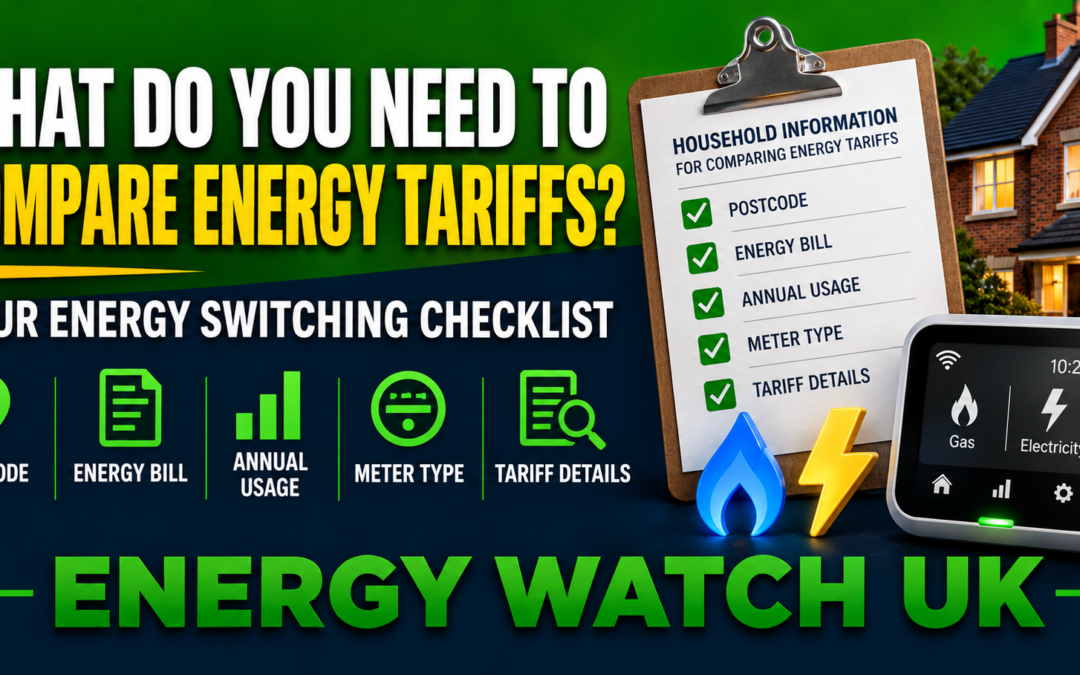
To receive the most accurate energy comparison, have the following information ready:
- Your postcode
- The name of your current energy supplier
- Your current tariff name
- Your annual gas and electricity usage in kWh
- Your current payment method
- Your meter type
- Your tariff end date
- Any exit fees attached to your current tariff
- Your latest meter readings, if available
You do not normally need all these details simply to start looking at your options. However, accurate usage and tariff information will produce a more meaningful comparison.
1. Your postcode
Energy tariff prices can differ by region because network costs and standing charges are not identical across Great Britain.
Your postcode allows the comparison to identify tariffs available in your energy region. It also confirms which suppliers and offers may be available at your address.
Energy Watch UK supports households across the country. Visit Areas We Cover to find information about comparing energy suppliers in your location.
2. Your current energy supplier
You should know which company currently supplies your gas and electricity.
If you have different suppliers for gas and electricity, record the details for both. You may be able to compare them separately or consider a dual-fuel tariff.
Your supplier’s name should appear on your bill, online account, banking records or recent correspondence.
3. Your tariff name
Your current tariff name helps establish whether you are on:
- A standard variable tariff
- A fixed-rate tariff
- A tracker tariff
- An Economy 7 or multi-rate tariff
- An electric vehicle tariff
- A prepayment tariff
- Another specialist tariff
This matters because tariffs work differently. A deal with a lower estimated annual cost may not necessarily suit your meter, payment preference or daily energy-use pattern.
4. Your annual energy usage
Your annual consumption in kilowatt-hours is one of the most important details in an energy comparison.
Look for two figures:
- Annual electricity usage in kWh
- Annual gas usage in kWh
These figures are usually shown on your bill or annual statement.
Using actual consumption is more accurate than comparing tariffs using only your monthly Direct Debit. Your payment amount may include account credit, debt repayments or an adjustment based on estimated usage.
If you cannot find your annual consumption, check your supplier’s online account or contact them directly.
5. Your current payment method
Energy prices can vary depending on how you pay.
Common payment methods include:
- Monthly Direct Debit
- Variable Direct Debit
- Payment on receipt of a bill
- Prepayment meter
When comparing tariffs, make sure the payment method shown is one you can and want to use.
A lower headline price is not helpful if the tariff requires a payment arrangement that does not suit your circumstances.
6. Your meter type
Your meter type affects which tariffs are suitable for your property.
Check whether you have:
- A standard credit meter
- A smart meter
- A prepayment meter
- An Economy 7 or multi-rate meter
- Separate gas and electricity meters
If you have an Economy 7 meter, it is useful to know how much electricity you use during the day and overnight.
Households with smart meters may also be able to consider time-of-use tariffs. These tariffs can charge different prices depending on when electricity is used.
7. Your tariff end date and exit fee
If you are on a fixed tariff, check when the contract ends and whether an exit fee applies.
An exit fee does not automatically mean you should stay on your current deal. It should be included in the overall comparison.
For example, a different tariff might still offer better value after accounting for the exit fee. Equally, switching too early might remove some or all of the potential benefit.
The aim is to compare the full position—not simply the advertised unit rate.
8. Your standing charges and unit rates
Your bill should show:
- Electricity unit rate in pence per kWh
- Electricity daily standing charge
- Gas unit rate in pence per kWh
- Gas daily standing charge
The unit rate is the amount charged for the energy you use. The standing charge is a daily amount payable regardless of how much energy you consume.
Compare both figures. A tariff with a low unit rate could have a higher standing charge, while another tariff may work differently.
Your likely annual cost is usually a better comparison measure than concentrating on one rate alone.
Do you need a meter reading before switching?
A recent meter reading is helpful when comparing tariffs, but it becomes particularly important when your switch takes place.
Providing an accurate reading around the switch date helps your old and new suppliers divide your usage correctly.
Keep a photograph of the meter reading for your records.
Your old supplier should then issue a final bill. If your account is in credit, check that the remaining balance is returned to you.
How long does it take to switch energy supplier?
A domestic energy switch should normally be completed within five working days, although you may be able to request a later switching date.
Your gas and electricity will not be physically disconnected while the supplier changes. The same pipes, cables and local energy network continue supplying the property.
Your new supplier should explain the next steps and confirm when the switch has completed.
Will the cheapest tariff always be the best tariff?
Not necessarily.
Price is important, but you should also consider:
- Tariff length
- Fixed or variable pricing
- Exit fees
- Payment method
- Customer service
- Meter compatibility
- Renewable-energy preferences
- Online account requirements
- Whether the tariff fits your usual energy-use pattern
A proper comparison should help you find a suitable tariff—not simply the lowest headline figure.
Should you compare tariffs before the October price-cap change?
Ofgem has confirmed that the typical annual price-cap figure will be £1,723 from 1 October 2026. The price cap limits unit rates and standing charges on standard variable tariffs; it is not a maximum limit on your total bill.
Your actual cost will still depend on how much energy you use, where you live, your meter and your payment method.
The approaching change makes September a sensible time to check your tariff, calculate your annual usage and compare the options available. That does not mean every household should automatically switch or fix. The right decision depends on the complete tariff comparison.
Compare energy tariffs with Energy Watch UK
Before starting, gather a recent bill and write down your annual gas and electricity usage.
You can then visit the Energy Watch UK Home page to begin comparing available options.
If you want to understand more about the process, visit our FAQs. You can also learn more about Energy Watch UK and the Author behind our comparison content.
Independent customer experiences are available on our Trustpilot profile.
There is no single tariff that is automatically right for every household. Comparing your actual usage, rates, standing charges, payment method and contract terms gives you a clearer basis for deciding whether to stay, change tariff or switch supplier.
Related Energy Watch UK guides
- October Energy Price Cap 2026 Confirmed: What It Means for Your Bills
- Energy Debt Hits £6bn: What to Do If You Can’t Pay Your Energy Bill
- Should I Switch My Energy Supplier Before October 2026?
Frequently asked questions
What information do I need to compare energy suppliers?
For the most accurate comparison, use your postcode, current supplier, tariff name, annual gas and electricity usage, payment method, meter type, tariff end date and any exit fees.
Can I compare energy tariffs without a bill?
Yes. You can begin using estimated consumption, but a recent bill or annual statement will normally produce a more accurate comparison.
Do I need my MPAN or MPRN to compare energy tariffs?
These supply numbers can help identify your electricity and gas accounts, but they are not always required for an initial comparison. They can normally be found on your energy bill.
Can I switch if I have a smart meter?
Yes. Having a smart meter does not normally prevent you from changing energy supplier. Check that your chosen tariff is compatible with your meter and any time-of-use features you want to retain.
Will my energy supply be interrupted when I switch?
No. Changing supplier does not require your gas or electricity to be disconnected. Your new supplier manages the transfer using the existing energy network.
Is the energy price cap the maximum I can pay?
No. The price cap limits the unit rates and standing charges that suppliers can apply to standard variable tariffs. Your total bill depends on the amount of energy you use.
About the Author
John – Your Local Energy Watch UK Expert
John provides straightforward information to help homeowners understand energy tariffs, price-cap changes and their options when comparing gas and electricity suppliers.
Last updated: 14th September 2026