
Written by John, Energy Watch UK
Last updated: 21 August 2026
Updated: 21 August 2026
Standing charges have become one of the most frustrating parts of household energy bills.
Even if you use very little gas or electricity, you can still pay a daily standing charge simply for being connected to the energy network.
That has led more households to ask:
Can I get an energy tariff with no standing charge?
Low and zero standing charge tariffs are receiving increased attention in 2026, with alternative tariff structures being explored to give households more choice.
But there’s an important catch.
A tariff with a lower standing charge isn’t automatically a cheaper energy tariff.
In many cases, reducing the standing charge means more of the cost is moved onto the price you pay for each unit of energy.
So who could benefit from a low or no standing charge tariff, and what should you compare before switching?
Energy Watch UK explains.
What Is an Energy Standing Charge?
A standing charge is a fixed daily amount you pay for having gas or electricity supplied to your property.
You normally pay it every day regardless of how much energy you actually use.
Your energy bill therefore consists mainly of two elements:
Standing charge + energy used at your unit rate
For example, reducing your electricity consumption can lower the usage portion of your bill, but it doesn’t normally remove the daily standing charge.
This is one reason standing charges have attracted so much attention from consumers.
Can You Get a No Standing Charge Energy Tariff in 2026?
There are some zero standing charge options in the market, but availability is limited and eligibility can depend on factors such as your meter and payment method.
There are also trials of lower standing charge tariffs taking place during 2026.
The aim is to give consumers more choice over how the costs of supplying energy are divided between standing charges and unit rates.
This could be particularly interesting for households that use relatively little energy.
However, it’s important not to look at the standing charge in isolation.
How Do Low Standing Charge Tariffs Work?
Imagine two tariffs.
Tariff A has a normal daily standing charge but a lower electricity unit rate.
Tariff B has a much lower standing charge but charges more for every kilowatt-hour of electricity you use.
If you use very little electricity, Tariff B could potentially work in your favour.
But if you’re a higher-energy household, the more expensive unit rate could outweigh everything you saved on the standing charge.
That’s why the words “no standing charge” don’t automatically mean “cheaper energy.”
The total annual cost matters.
Who Could Benefit From a Lower Standing Charge?
Lower standing charge tariffs could potentially be more attractive to low-energy users.
Examples might include:
- People living alone
- Smaller households
- Properties that are empty for long periods
- Second homes
- Households that have significantly reduced their consumption
- People who spend long periods away from home
The less energy you consume, the more significant a fixed daily charge can become as a proportion of your overall bill.
But every household is different.
The only reliable way to determine whether a tariff is better is to compare the complete cost.
Who Might Be Worse Off?
Higher-energy households need to be particularly careful.
If a supplier reduces the standing charge but increases the unit rate, households using large amounts of gas or electricity could potentially end up paying more overall.
That could include larger families or homes with high electricity consumption.
It may also affect households using electric heating or other high-consumption appliances.
The headline standing charge might look attractive, but the unit rate could make the tariff more expensive.
What Should I Compare?
When comparing a normal tariff with a low standing charge tariff, check all the main charges.
Look at:
- Electricity standing charge
- Electricity unit rate
- Gas standing charge
- Gas unit rate
- Annual electricity consumption
- Annual gas consumption
- Tariff duration
- Exit fees
- Payment method
- Meter requirements
Then estimate what each tariff would cost based on your actual annual consumption.
Don’t choose purely because one tariff advertises a lower standing charge.
How Much Are Standing Charges in 2026?
Standing charges vary depending on factors including where you live and how you pay for your energy.
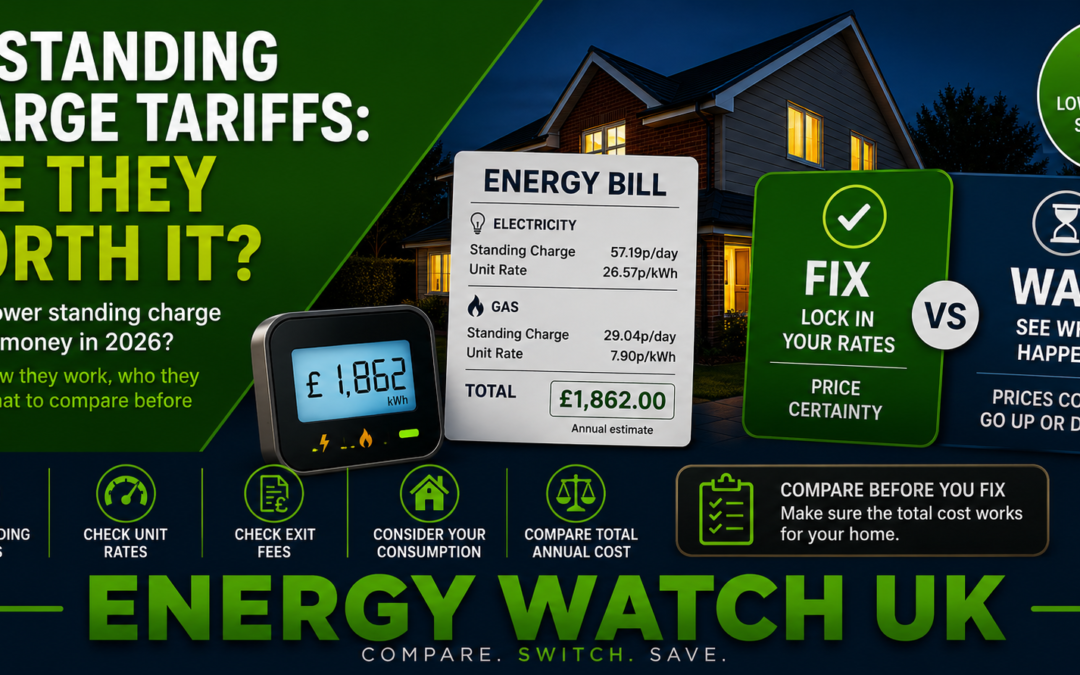
Under the current July to September 2026 price-cap period, the national-average Direct Debit standing charges are approximately:
Electricity: 57.19p per day
Gas: 29.04p per day
Actual rates vary by region.
That means standing charges can add up to a significant amount over a full year before considering the gas or electricity you actually consume.
If you are wondering why your overall household costs have recently changed, read Why Has My Energy Bill Gone Up This Month?
Why Do We Have Energy Standing Charges?
Standing charges help cover fixed costs associated with supplying energy.
These can include costs connected with maintaining and operating energy networks and other costs involved in supplying households.
These costs exist even when an individual household uses very little energy.
The debate is therefore less about whether those costs exist and more about how they should be recovered from consumers.
Should everyone pay a relatively high fixed daily amount?
Or should more of the cost be moved onto the energy people actually consume?
Low standing charge tariffs provide another way of structuring those costs.
Is a Zero Standing Charge Tariff Always Better for Low Users?
Not necessarily.
Low-energy users may appear to be the obvious beneficiaries, but you still need to look at the unit rate.
A household could save money by removing a daily standing charge but then lose those savings through a significantly higher price per kilowatt-hour.
There will usually be a point at which the extra cost of each unit starts outweighing the standing-charge saving.
That’s why your annual consumption is so important.
How Do I Find My Annual Energy Consumption?
Check your latest energy statement or your online supplier account.
Look for your estimated or actual annual consumption in kilowatt-hours (kWh).
Ideally, find separate figures for:
Electricity annual consumption
and
Gas annual consumption
These numbers make comparing tariffs much more meaningful.
Instead of asking which tariff has the lowest standing charge, you can ask:
Which tariff is likely to cost my household less over a full year?
That’s the question that matters.
Could Standing Charges Change in the Future?
Standing charges are an active area of change in the UK energy market.
Lower standing charge tariff trials are giving consumers alternative ways of paying for energy, particularly households concerned about paying significant fixed costs regardless of usage.
That doesn’t necessarily mean standing charges will simply disappear.
Energy networks and suppliers still have fixed costs that need to be recovered.
What could change is how those costs are distributed across energy tariffs.
What About the October 2026 Energy Price Cap?
Standing charges aren’t the only energy cost households should be watching.
Energy prices are also expected to change again when the next price-cap period begins in October.
We’ve covered the latest developments in Energy Price Cap Forecast October 2026: Energy Bills Could Rise Again.
However, don’t choose a low standing charge tariff purely because energy prices are forecast to change.
Compare the complete tariff.
Could Inflation Affect Energy Costs?
Energy costs have already contributed to wider changes in UK household finances this year.
Higher gas and electricity prices have played a role in recent inflation figures.
You can read more in our guide UK Inflation Hits 2.9% as Energy Bills Rise Again in 2026.
For consumers, the important thing is to focus on the costs they can actually compare and control.
Should I Wait for the October Price Cap?
You don’t necessarily need to wait until October to understand your current energy costs.
You can check your existing unit rates, standing charges and annual consumption now.
For more information on what could happen later this year, see October Energy Price Cap 2026: Latest Forecast and What We Know.
Remember that a price-cap headline figure doesn’t tell you whether a particular tariff will be best for your household.
Your own consumption matters.
Should I Switch Energy Supplier?
If your current tariff no longer looks competitive, comparing other suppliers could be worthwhile.
But don’t focus on just one number.
A tariff could offer a lower standing charge while having a higher unit rate.
Another could have a higher standing charge but cheaper energy usage.
You need to consider the total estimated annual cost.
Our guide Should I Switch My Energy Supplier Before October 2026? explains some of the other factors worth considering before making a change.
Does Where I Live Affect My Standing Charge?
Yes.
Energy standing charges can vary by region.
Where you live can therefore affect the rates available to your household.
This is another reason generic national figures don’t always tell you exactly what you’ll pay.
Visit our Areas We Cover page to find information about energy comparison services in your area.
Are Low Standing Charge Tariffs Good for Empty Properties?
Potentially, and this is one situation where they could be particularly interesting.
A property that remains empty for long periods may consume very little energy while still accumulating standing charges every day.
Examples could include second homes or properties that aren’t occupied throughout the year.
However, you still need to check the tariff conditions and unit rates.
If the property starts consuming significantly more energy, the economics of the tariff could change.
What About Solar Panels and Low-Energy Homes?
Households that generate some of their own electricity or have taken significant steps to reduce grid consumption may also be interested in lower standing charge options.
Again, the calculation depends on how much electricity you still import from the grid and the rates you’re being offered.
A low-energy home isn’t automatically better off on a low standing charge tariff.
Run the numbers first.
Low Standing Charge vs Low Unit Rate: Which Is Better?
There is no universal winner.
For a very low-energy household, reducing fixed daily costs could potentially be valuable.
For a higher-energy household, securing a competitive unit rate may be more important.
Think about it this way:
Low usage = standing charge can matter more
High usage = unit rate can matter more
But always compare the total estimated annual cost rather than relying on that rule alone.
Compare Energy Tariffs With Energy Watch UK
The cheapest-looking standing charge doesn’t necessarily mean the cheapest energy tariff.
Energy Watch UK helps households understand their energy costs and compare available gas and electricity tariffs.
Visit our Home page to compare your options.
You can also see what customers say about Energy Watch UK on Trustpilot.
Comparing gives you the information you need to decide whether staying with your current tariff or switching could make sense for your household.
Frequently Asked Questions
For more help with energy tariffs, bills and switching, visit our FAQs.
Can I get an energy tariff with no standing charge?
Some zero standing charge options exist, although availability can be limited and eligibility may depend on your meter type and payment method. Lower standing charge tariff trials are also taking place during 2026.
Is a no standing charge tariff cheaper?
Not necessarily. A lower standing charge can be accompanied by a higher unit rate, so you need to compare the total estimated annual cost.
Who benefits most from low standing charges?
Lower-energy users may potentially benefit more because fixed daily charges make up a greater proportion of their overall costs. However, the unit rate must also be considered.
Do I pay a standing charge if I use no energy?
On a conventional tariff with a standing charge, you normally continue paying the daily charge even when little or no energy is being consumed.
Why are electricity standing charges higher than gas?
The costs incorporated into electricity and gas standing charges differ, including network-related costs. Rates can also vary by region.
Are standing charges the same everywhere in the UK?
No. Standing charges can vary depending on where you live, your payment method and your tariff.
Should I switch purely to get a lower standing charge?
No. Compare the unit rates, standing charges, tariff conditions, exit fees and estimated total annual cost before deciding.
Could standing charges disappear completely?
The way standing charges are structured is being reviewed and alternative tariffs are being trialled. However, there are still fixed costs associated with supplying energy, so a zero standing charge doesn’t mean those underlying costs disappear.
Final Thoughts
No standing charge energy tariffs sound immediately attractive.
After all, why pay every day before you’ve even switched on a light?
But energy tariffs aren’t quite that simple.
Reducing or removing the standing charge can mean paying more for the energy you actually use.
For some low-energy households, that trade-off could potentially work.
For others, particularly higher-energy users, a competitive unit rate could be far more important.
Before switching, check:
Your annual consumption.
Your current standing charges.
Your current unit rates.
The new tariff’s standing charges.
The new tariff’s unit rates.
Any exit fees.
Then compare the estimated annual cost.
Don’t choose the tariff with the lowest standing charge. Choose the tariff that makes sense for your overall energy usage.
Author
John — Your Local Energy Watch UK Expert
Helping UK homeowners understand their energy bills, compare gas and electricity tariffs and make informed decisions about household energy.
Learn more about Energy Watch UK on our About Us page.