
Written by John, Energy Watch UK
Last updated: 9 August 2026
Should you stay on the Energy Price Cap or switch to a fixed energy tariff?
It is one of the most important questions for homeowners approaching autumn 2026.
Millions of households are currently protected by the Ofgem Energy Price Cap on standard variable tariffs, while energy suppliers also offer fixed deals that can provide certainty over future unit rates.
But being protected by the Price Cap does not automatically mean you are on the cheapest energy tariff.
Likewise, switching to a fixed tariff does not automatically mean you will save money.
Here is what homeowners should compare before deciding.
Quick Answer: Is the Energy Price Cap or a Fixed Tariff Cheaper?
It depends on the tariff available to your household.
The Energy Price Cap limits the amount suppliers can charge per unit of gas and electricity, along with standing charges, on eligible default tariffs.
A fixed tariff normally locks your unit rates for a set period.
The cheapest option therefore depends on:
- The fixed tariff rates available to you
- Your current Price Cap rates
- Your annual gas consumption
- Your annual electricity consumption
- Standing charges
- Exit fees
- How long the tariff is fixed for
- Your region and payment method
The best comparison uses your actual annual consumption in kWh, rather than simply comparing advertised annual bill figures.
What Is the Energy Price Cap Right Now?
The current Energy Price Cap applies from 1 July to 30 September 2026.
For a typical dual-fuel household paying by Direct Debit, Ofgem currently quotes an annualised figure of £1,862 under the consumption basis used for its July announcement.
Average Direct Debit rates are currently:
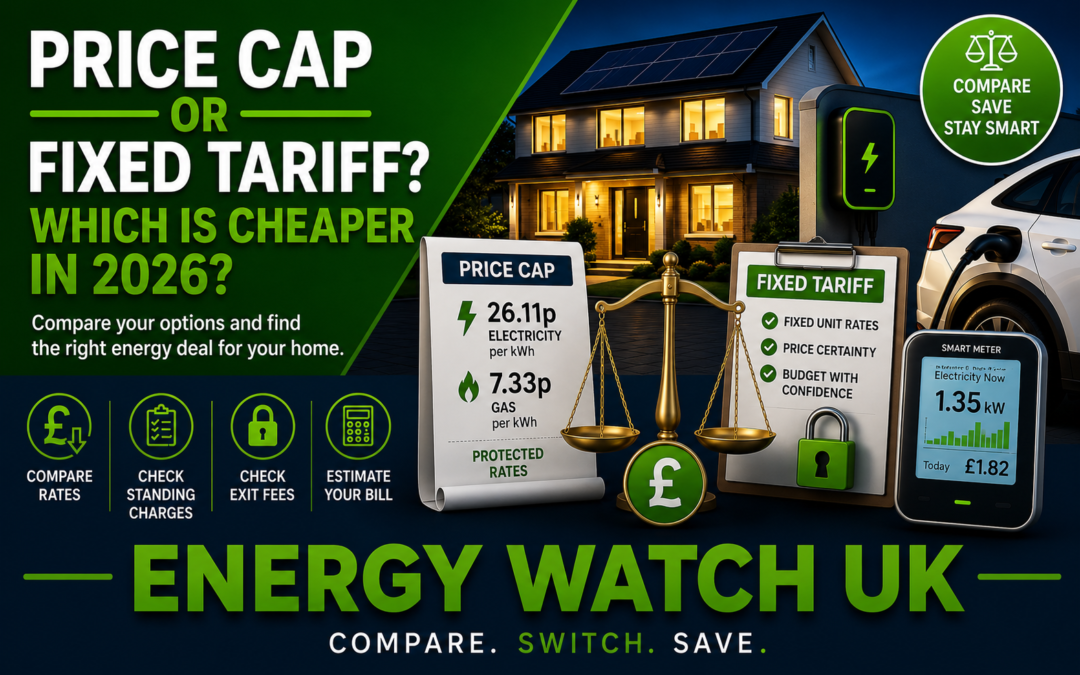
Electricity unit rate: 26.11p per kWh
Electricity standing charge: 57.19p per day
Gas unit rate: 7.33p per kWh
Gas standing charge: 29.04p per day
These are national averages and include the current VAT treatment. Your actual rates can vary according to region and circumstances.
Does the Energy Price Cap Limit My Total Bill?
No.
This is one of the most important things homeowners need to understand.
The Energy Price Cap is not a maximum annual household bill.
It controls the rates suppliers can charge customers on eligible default tariffs.
If your household consumes more energy, you can pay considerably more than the headline figure.
If you consume less, you could pay less.
This is why comparing a fixed tariff against a headline Price Cap figure alone can be misleading.
What Is a Fixed Energy Tariff?
A fixed energy tariff normally fixes your gas and electricity unit rates for an agreed period.
Common fixed periods include:
- 12 months
- 18 months
- 24 months
Your total bill is not fixed.
If you consume more gas or electricity, you will still pay more.
What a fixed tariff provides is greater certainty over the rates you will pay during the fixed period, subject to the tariff’s terms.
What Are the Advantages of a Fixed Energy Tariff?
The biggest advantage is certainty.
If wholesale energy prices increase and future Price Caps rise, customers on suitable fixed tariffs may be protected from those increases in unit rates.
This can make budgeting easier.
A competitive fixed tariff can also potentially cost less than remaining on a standard variable tariff.
But this depends entirely on the deal.
What Are the Disadvantages of Fixing Your Energy Tariff?
The biggest risk is that energy prices fall after you fix.
If cheaper tariffs become available later, you could find yourself paying higher rates.
Some fixed tariffs also charge exit fees if you leave before the contract ends.
Before fixing, always check:
Unit rates
Standing charges
Tariff duration
Exit fees
Estimated annual cost
Do not focus on only one number.
What Could Happen to the Energy Price Cap in October 2026?
The October–December Energy Price Cap has not yet been officially confirmed.
Ofgem says it will announce the next cap by 26 August 2026.
Cornwall Insight’s 21 July forecast puts the October cap at approximately £1,700 using Ofgem’s new Typical Domestic Consumption Values.
However, the definition of a typical household has changed.
Cornwall Insight says the equivalent figure under the previous consumption definition would be around £1,906 and describes its latest forecast as approximately a 2% like-for-like increase on the current cap.
This is why comparing actual tariff rates is more useful than comparing headline Price Cap figures.
Should I Fix My Energy Tariff Before the October Price Cap?
There is no universal answer.
If you find a fixed tariff offering attractive unit rates, reasonable standing charges and acceptable exit fees, fixing could provide both savings and certainty.
However, if a fixed tariff is considerably more expensive than your existing rates, you would effectively be paying a premium for that certainty.
The important thing is to compare before deciding.
You do not have to switch simply because you compare tariffs.
How Do I Know If a Fixed Tariff Is Cheaper?
Start with your annual energy consumption.
You can normally find this on your latest energy statement or online supplier account.
Look for:
Annual electricity consumption in kWh
and
Annual gas consumption in kWh
Then compare how much each tariff would cost using those figures.
A simplified calculation is:
Annual electricity consumption × electricity unit rate
plus
365 × electricity standing charge
Then repeat the calculation for gas.
Add both together to estimate your annual cost.
Why Should I Use kWh Instead of My Monthly Direct Debit?
Because your Direct Debit is a payment arrangement, not a precise measure of consumption.
Your supplier may spread your estimated annual energy costs across 12 monthly payments.
That means your Direct Debit could stay the same even though your actual energy consumption changes considerably between summer and winter.
Your annual kWh consumption gives you a much stronger basis for comparing tariffs.
Read our guide What Will My Energy Bill Be From October 2026? for more information on calculating your household costs.
Do Standing Charges Matter When Comparing Tariffs?
Yes.
A tariff can have a cheaper electricity unit rate but a higher standing charge.
Depending on your consumption, that could make the supposedly cheaper tariff more expensive overall.
Standing charges are particularly important for households that use relatively little energy because they are generally payable every day regardless of consumption.
Read our guide:
What Is an Energy Standing Charge in 2026?
Can I Switch If I Am Already on a Fixed Tariff?
Usually, yes, but you need to check your contract.
Some fixed tariffs have exit fees.
For example, you could potentially save £100 by switching but face £150 in exit fees.
In that situation, switching early may not make financial sense.
Read:
Can You Change Energy Supplier During Your Contract?
Check your existing tariff terms before making a decision.
Is the Cheapest Energy Tariff Always the Best?
Not necessarily.
Price matters, but homeowners should also consider:
- Customer service
- Billing accuracy
- Supplier reputation
- Smart meter support
- Exit fees
- Payment options
- Tariff flexibility
- Length of the contract
Saving a very small amount each year may not justify moving to a tariff that is poorly suited to your household.
Should EV Owners Stay on the Energy Price Cap?
Not automatically.
Electric vehicle owners can have very different electricity consumption patterns.
Some specialist EV tariffs provide cheaper electricity during overnight periods when vehicles are normally charged.
If you can move a significant proportion of your consumption into cheaper hours, an EV tariff could potentially be more suitable than a conventional tariff.
Read our guide:
Are EV Energy Tariffs Worth It in 2026?
Compare the entire tariff, including daytime electricity rates and standing charges, rather than looking only at the advertised overnight rate.
What Uses the Most Electricity in Your Home?
Understanding your electricity consumption can also improve your tariff comparison.
High-consumption appliances and electric heating can significantly change which tariff works best for your household.
Read:
What Uses the Most Electricity in UK Homes Today?
Reducing unnecessary electricity consumption can lower your bills regardless of which supplier you choose.
Should I Wait Until 26 August Before Switching?
Not necessarily.
Waiting until Ofgem announces the October Price Cap gives you more information about upcoming capped rates.
However, fixed tariffs available today can change or be withdrawn.
There is nothing wrong with comparing tariffs now.
If you find a competitive deal, you can evaluate it against your current tariff.
The important thing is not to rush into a tariff because you are worried about the next Price Cap.
Compare the numbers first.
What Should I Compare Before Switching Energy Supplier?
Before switching, find the following information:
- Annual electricity consumption in kWh
- Annual gas consumption in kWh
- Current electricity unit rate
- Current gas unit rate
- Current electricity standing charge
- Current gas standing charge
- Proposed tariff unit rates
- Proposed tariff standing charges
- Exit fees
- Tariff end date
Then compare the estimated annual cost.
This provides a much better indication of whether switching could save you money.
Energy Price Cap or Fixed Tariff: Which Should I Choose?
There is no single answer for every homeowner.
The Energy Price Cap provides protection for households on eligible default tariffs, but it does not guarantee you are receiving the cheapest energy available.
A fixed tariff can provide certainty and could potentially save money, but it can also leave you paying more if prices fall.
The right decision comes down to the rates available to your household.
Instead of trying to predict exactly what energy markets will do, compare the tariffs you can actually access against what you are currently paying.
That turns a difficult question into a much simpler calculation.
Frequently Asked Questions
Is a fixed energy tariff cheaper than the Energy Price Cap?
It can be, but not every fixed tariff is cheaper. Compare unit rates, standing charges, exit fees and estimated annual cost using your household’s actual consumption.
What is the Energy Price Cap in August 2026?
The July–September cap is currently in force. Average Direct Debit rates are 26.11p/kWh for electricity and 7.33p/kWh for gas, with average daily standing charges of 57.19p for electricity and 29.04p for gas.
When is the next Energy Price Cap announced?
Ofgem says the cap covering 1 October to 31 December 2026 will be announced by 26 August 2026.
Does fixing my energy tariff fix my total bill?
No. A fixed tariff normally fixes your unit rates. Your total bill still depends on how much energy you consume.
Can I switch energy suppliers before October?
Yes, subject to your existing tariff terms. Check whether exit fees apply before switching.
Should I wait for the October Price Cap before fixing?
Not necessarily. You can compare fixed tariffs now without committing to switch. Waiting gives you more information, but today’s deals may change.
How do I find the cheapest tariff for my home?
Use your actual annual gas and electricity consumption in kWh and compare the total projected annual cost, including unit rates and standing charges.
Compare Energy Suppliers With Energy Watch UK
Energy Watch UK helps homeowners understand energy tariffs and compare energy suppliers based on their individual circumstances.
Visit our Home page for more information about comparing energy suppliers.
You can also learn more About Us, explore the Areas We Cover, read our FAQs and see customer feedback on Trustpilot.
Our aim is to make energy comparison straightforward and help homeowners make informed decisions about their gas and electricity tariffs.
About the Author
John – Your Local Energy Watch UK Expert
John is your local Energy Watch UK expert, helping homeowners understand energy suppliers, tariffs, switching and household energy costs.
Through straightforward and practical information, his aim is to help homeowners better understand their energy options and make informed decisions.