
Written by John, Energy Watch UK
Last updated: 14 August 2026
Updated August 2026
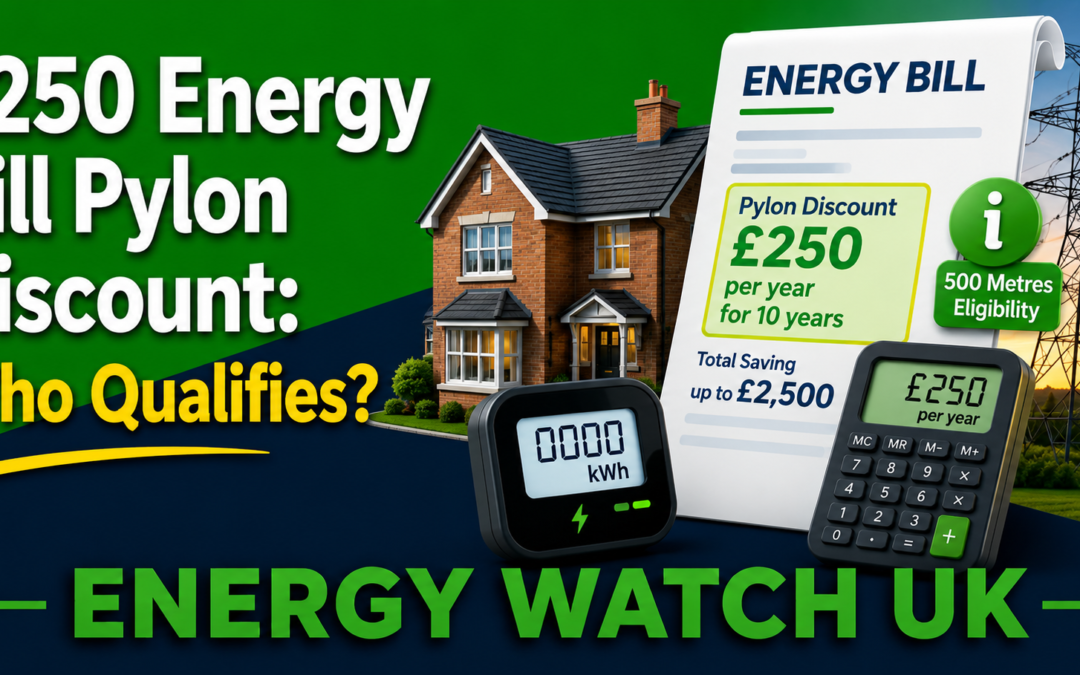
Households living near certain new electricity infrastructure could receive £250 a year off their electricity bills under the government’s Bill Discount Scheme.
For qualifying households, the support could continue for up to 10 years, potentially making the discount worth £2,500 in total.
But not everyone who lives near an electricity pylon will qualify.
Here’s what homeowners need to know about the scheme, who could receive the discount and when payments are expected to begin.
What Is the £250 Energy Bill Pylon Discount?
The Bill Discount Scheme is designed to provide a direct financial benefit to households living closest to certain new or significantly upgraded electricity transmission infrastructure.
Eligible households could receive:
£250 per year towards their electricity bills for up to 10 years.
That could mean a total benefit of:
£2,500 per qualifying household.
The scheme forms part of wider plans to expand and upgrade Britain’s electricity network.
Who Qualifies for the £250 Energy Bill Discount?
The key factor is where your property is located in relation to qualifying electricity infrastructure.
Households generally need to be located within 500 metres of eligible new or significantly upgraded overhead transmission infrastructure.
However, living close to an existing electricity pylon does not automatically mean you’ll qualify.
The infrastructure itself needs to be part of a project covered by the scheme.
How Close Do I Need to Live to a Pylon?
The important distance is:
500 metres.
Homes within 500 metres of qualifying infrastructure may be eligible for the annual discount.
However, homeowners shouldn’t assume that being within 500 metres of any electricity pylon is enough.
Eligibility depends on the specific infrastructure project.
Is It £250 Once or £250 Every Year?
For qualifying households, the discount could be worth £250 every year for up to 10 years.
That means the potential maximum benefit is:
£250 x 10 years = £2,500.
This makes the scheme considerably more valuable than a one-off £250 payment.
When Will the £250 Energy Bill Discount Start?
The first discounts are expected to begin from 2027.
The exact timing will depend on the qualifying infrastructure project and when construction reaches the required stage.
Households near projects that haven’t started construction may therefore need to wait before receiving the discount.
Do I Need to Apply?
Most eligible domestic households are expected to receive the discount automatically rather than having to complete a traditional application.
The qualifying property should be identified and the discount applied through the electricity billing system.
However, individual circumstances may vary, so households close to one of the eligible projects should check official information as the scheme develops.
Will I Receive £250 in Cash?
The support is designed as an electricity bill discount, rather than simply a £250 cash payment.
Eligible households should therefore expect the benefit to be applied towards their electricity costs.
More detailed information about exactly how the credit will appear on household bills should become available as the scheme moves towards its 2027 launch.
Does Every Electricity Pylon Qualify?
No.
This is probably the most important point for homeowners.
The scheme does not mean everyone who currently lives within 500 metres of an electricity pylon will receive £250.
It applies to households near qualifying new or significantly upgraded transmission infrastructure included within the scheme.
If an existing pylon has been near your property for years and there is no qualifying new infrastructure project, you shouldn’t assume you’ll be eligible.
Which Parts of the UK Are Included?
The first group of qualifying infrastructure projects includes locations across parts of England, Scotland and Wales.
More households could become eligible as Britain’s electricity transmission network continues to expand.
If major electricity infrastructure is being constructed near your home, keep an eye on official information relating to that particular project.
You can also visit our Areas We Cover page to find Energy Watch UK information and services available in your area.
Why Is New Electricity Infrastructure Being Built?
Britain’s electricity system is changing.
More renewable generation, electrification and increasing electricity demand mean additional transmission capacity is required to move electricity around the country.
That requires investment in pylons, overhead transmission lines, substations and other infrastructure.
The Bill Discount Scheme is intended to ensure that households living closest to qualifying infrastructure receive a direct financial benefit.
What If I Live Just Outside the 500-Metre Area?
Properties outside the qualifying distance wouldn’t normally receive the annual discount under the current scheme.
If your home is close to the boundary, don’t rely solely on your own estimate.
Wait for official confirmation of the qualifying properties associated with the infrastructure project.
Can I Still Switch Energy Supplier If I Receive the Discount?
The scheme shouldn’t prevent eligible households from comparing or switching energy suppliers.
The benefit relates to the qualifying property and infrastructure rather than being a normal loyalty discount offered by one energy supplier.
That means it’s still worth periodically checking whether your underlying energy tariff remains competitive.
Visit our Home page to compare available energy options.
Not Eligible for the £250 Discount?
The majority of UK households won’t live within 500 metres of qualifying new electricity infrastructure.
However, there may still be opportunities to reduce what you’re paying for gas and electricity.
One of the simplest things you can do is review your existing tariff.
Check:
- Electricity unit rates
- Gas unit rates
- Standing charges
- Fixed versus variable tariffs
- Contract length
- Exit fees
- Your actual annual energy usage
Don’t automatically assume that remaining with the same supplier or tariff is your cheapest option.
Should You Fix or Stay on a Price-Capped Tariff?
This is another important decision for households reviewing their energy costs in 2026.
A fixed tariff can provide certainty because your unit rates are locked for an agreed period.
A variable tariff can change as the Ofgem price cap changes.
Neither option is automatically better for every household.
For a detailed comparison, read our recent guide:
Energy Price Cap or Fixed Tariff: Which Is Cheaper?
This explains what homeowners should consider when comparing fixed and variable energy deals.
What Could Happen to Energy Bills From October 2026?
The next Ofgem price-cap period begins in October.
Changes to the cap can affect millions of households on standard variable tariffs.
If you’re trying to decide whether to switch, fix or wait, read:
What Will My Energy Bill Be From October 2026?
The guide explains what homeowners should watch as the next price-cap period approaches.
Have You Got an Electric Vehicle?
EV owners should also check whether a specialist electricity tariff could work better for their household.
Some EV tariffs offer significantly cheaper electricity during specific overnight charging periods, although daytime rates and standing charges also need to be considered.
Read:
Are EV Energy Tariffs Worth It in 2026?
It explains what to compare before choosing an EV energy tariff.
Compare Energy Suppliers With Energy Watch UK
Whether or not you’re eligible for the £250 pylon discount, it’s worth knowing whether your current energy tariff remains competitive.
Energy Watch UK helps homeowners compare available gas and electricity tariffs and understand their options before switching.
Comparing doesn’t mean you have to change supplier.
It simply lets you see the options available before deciding what works best for your household.
You can also visit our Home page, learn more About Us, see our Areas We Cover, read our FAQs and see what customers say about Energy Watch UK on Trustpilot.
Frequently Asked Questions
Who qualifies for the £250 energy bill discount?
Households located within the qualifying distance of eligible new or significantly upgraded electricity transmission infrastructure may receive the discount.
How close do I need to live to a pylon?
The key eligibility distance is within 500 metres of qualifying infrastructure.
Does an existing electricity pylon qualify?
Not automatically. The scheme is aimed at households affected by qualifying new or significantly upgraded electricity transmission infrastructure.
How much is the discount?
Eligible households could receive £250 per year.
How long could I receive it?
The discount could continue for up to 10 years, potentially providing a total benefit of £2,500.
When does the scheme start?
The first household discounts are expected from 2027, depending on the progress of individual qualifying infrastructure projects.
Do I have to apply?
Most eligible domestic households are expected to receive the discount automatically, although households should check the arrangements applying to their particular project.
Can I switch energy supplier while receiving the discount?
The scheme shouldn’t prevent households from comparing or switching energy supplier.
What if I don’t qualify?
You can still review your existing gas and electricity tariff and compare available options to see whether changing tariff or supplier could reduce your energy costs.
Final Thoughts
The new £250 annual energy bill discount could provide meaningful support for households living closest to Britain’s new electricity infrastructure.
For qualifying homes, the benefit could eventually be worth as much as £2,500 over 10 years.
But remember:
Living near an electricity pylon doesn’t automatically mean you qualify.
The property needs to be within the qualifying distance of infrastructure covered by the scheme.
And for the millions of UK households who won’t qualify, reviewing your existing energy tariff remains one of the simplest ways to check whether you’re paying more than necessary.
Author
John — your local Energy Watch UK expert
Helping UK homeowners understand their energy options and compare available gas and electricity tariffs.