
Written by John, Energy Watch UK
Last updated: 8 August 2026
Quick answer
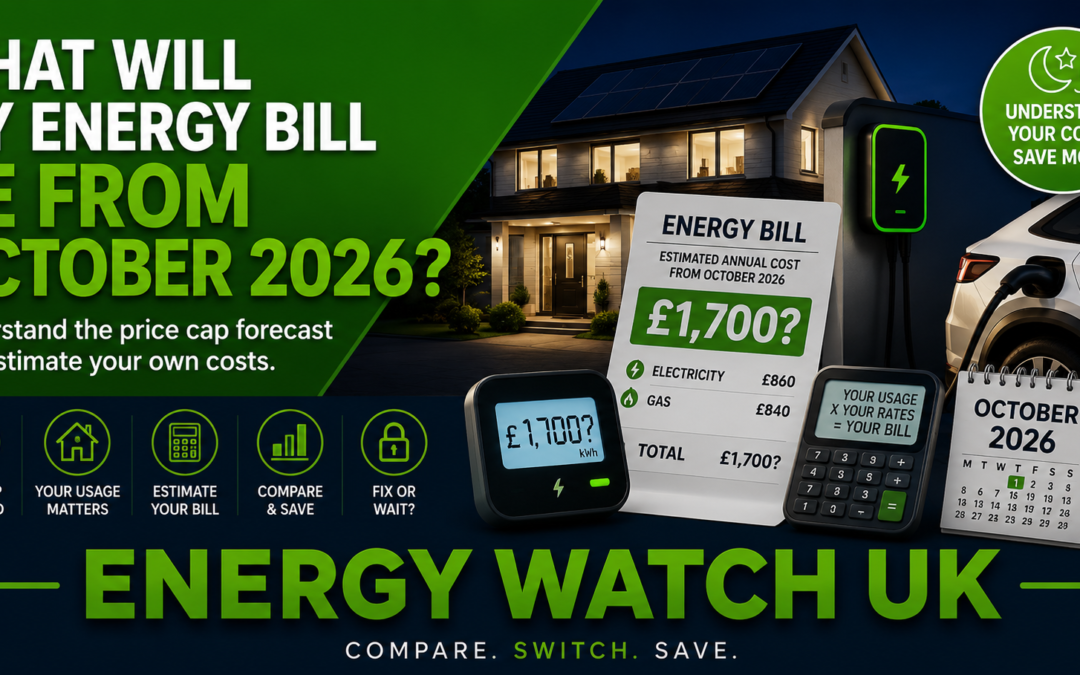
You may have seen forecasts suggesting the next Energy Price Cap could be around £1,700 a year for a typical household.
But this does not mean your energy bill will automatically be £1,700.
Your actual gas and electricity costs depend on how much energy your household uses, the tariff you are on, your standing charges, where you live and how you pay.
There is also an important change to the way a “typical household” is calculated in 2026, which can make comparing headline Energy Price Cap figures confusing.
Here is what homeowners need to know.
What Is the October 2026 Energy Price Cap Forecast?
The official Energy Price Cap for October to December 2026 has not yet been announced.
The latest Cornwall Insight forecast estimates an annualised cost of around £1,700 for a typical dual-fuel household paying by Direct Debit, based on Ofgem’s newer Typical Domestic Consumption Values.
However, this is still a forecast rather than the final figure.
Ofgem will confirm the actual rates that apply from October.
This means homeowners should be careful about making financial decisions based purely on the £1,700 headline.
Does the £1,700 Energy Price Cap Mean My Bill Cannot Be Higher?
No.
This is one of the biggest misunderstandings surrounding the Energy Price Cap.
The Energy Price Cap does not place a £1,700 maximum on your household energy bill.
Instead, it limits the rates that suppliers can charge customers on eligible default tariffs.
Your actual bill is determined largely by how much gas and electricity you consume.
Use more energy and you can pay considerably more than the headline figure.
Use less energy and you could pay considerably less.
Why Does the October Price Cap Look Lower?
There is an important change homeowners need to understand when comparing 2026 price-cap figures.
Ofgem has updated its Typical Domestic Consumption Values to reflect changes in average household energy consumption.
The new typical annual consumption figures are:
Electricity: 2,700 kWh
Gas: 11,500 kWh
This means headline price-cap figures calculated using the new consumption levels cannot simply be compared with older headline figures using different consumption assumptions.
That is why homeowners should increasingly focus on unit rates and their own annual kWh consumption rather than simply comparing two headline price-cap numbers.
How Much Will My Energy Bill Be From October 2026?
The best way to estimate your energy costs is to use your household’s actual annual consumption.
You can normally find this information on your latest energy bill, annual statement or online supplier account.
Look for:
Annual electricity consumption in kWh
and
Annual gas consumption in kWh
Once you know these figures, you can make a much more meaningful comparison between tariffs.
How Do I Calculate My Electricity Bill?
A simple calculation is:
Annual electricity usage × electricity unit rate
Then add:
Electricity standing charge × 365 days
For example, if your household uses 3,000 kWh of electricity each year, you would multiply 3,000 by the electricity unit rate offered by the tariff.
Then add the annual standing-charge cost.
This provides a much more useful estimate than assuming your household will pay the headline Energy Price Cap figure.
How Do I Calculate My Gas Bill?
The principle is the same.
Take your:
Annual gas consumption in kWh × gas unit rate
Then add:
Gas standing charge × 365 days
Finally, add your estimated annual gas and electricity costs together.
Remember that actual tariff rates can vary depending on your region, payment method and meter type.
Why Is My Monthly Direct Debit Different From My Actual Energy Usage?
Your monthly Direct Debit is not necessarily the amount of energy you consumed during that particular month.
Many suppliers estimate your expected annual energy costs and divide them into monthly payments.
This allows customers to build credit during periods of lower consumption, which can then help cover higher winter energy usage.
Therefore, don’t judge your energy consumption purely by the amount leaving your bank account each month.
Check the actual kWh consumed as well.
What Uses the Most Electricity in a UK Home?
Understanding where your electricity goes can help you make sense of your bill.
Some appliances consume considerably more electricity than others, particularly when they generate heat.
Tumble dryers, electric ovens, washing machines, dishwashers, immersion heaters and electric heating can all contribute significantly to household consumption.
If you want to identify where your electricity is going, read our guide:
What Uses the Most Electricity in UK Homes Today?
This is particularly useful before comparing tariffs because reducing unnecessary consumption can sometimes save money regardless of which supplier you use.
What About Energy Standing Charges?
Standing charges are another important part of your bill.
A standing charge is normally charged every day regardless of how much gas or electricity you use.
This means households with relatively low energy consumption can still face a significant annual cost before they have used a single unit of energy.
Read our full guide:
What Is an Energy Standing Charge in 2026?
When comparing tariffs, always look at both the unit rate and standing charge.
A tariff advertising an attractive unit rate may not necessarily be the cheapest overall if its standing charge is considerably higher.
Should I Fix My Energy Tariff Before October?
There is no universal answer.
A fixed tariff can provide greater certainty because your unit rates are normally fixed for an agreed period.
However, fixing also means you could miss out if cheaper tariffs become available later.
Before accepting a fixed tariff, compare:
- Electricity unit rate
- Gas unit rate
- Electricity standing charge
- Gas standing charge
- Length of the fixed period
- Exit fees
- Estimated annual cost
- Your actual annual energy consumption
Do not choose a fixed tariff simply because its advertised annual figure looks cheaper.
Can I Change Energy Supplier During My Contract?
Potentially, yes.
Being on a fixed tariff does not necessarily prevent you from changing supplier.
However, you may have to pay an exit fee.
Before switching, check your existing tariff’s terms and calculate whether the potential saving from moving outweighs any exit charges.
Read our guide:
Can You Change Energy Supplier During Your Contract?
This explains what homeowners should check before switching early.
Should EV Owners Compare Specialist Energy Tariffs?
Yes.
If you charge an electric vehicle at home, your electricity consumption can be substantially different from that of a household without an EV.
Some specialist EV tariffs provide cheaper electricity during specific overnight or off-peak periods.
This can potentially reduce the cost of home charging if your usage fits the tariff.
Read:
Are EV Energy Tariffs Worth It in 2026?
When comparing an EV tariff, don’t look only at the cheap overnight rate. Check the daytime rate, standing charge, off-peak hours and your total household electricity usage.
Should You Believe Every Energy-Saving Tip?
No.
There is a huge amount of energy-saving advice online, and not all of it makes a meaningful difference to household bills.
Some frequently repeated tips can save very little, while changes to high-consumption appliances or heating habits can have a much greater effect.
Our guide 10 Energy Saving Myths Homeowners Still Believe looks at some common misconceptions.
The most useful approach is to concentrate on changes that genuinely reduce the number of kWh your household consumes.
Does Where I Live Affect My Energy Bill?
Yes.
Energy tariff rates can vary across different regions of the UK.
Two households with exactly the same consumption could therefore have slightly different costs depending on where they live, their tariff and their payment method.
You can visit our Areas We Cover page to find more information about Energy Watch UK services in your area.
Should I Compare Energy Suppliers Before October?
It is worth comparing.
Comparing does not mean you have to switch.
Instead, it allows you to see how your current tariff compares with alternatives available to your household.
When comparing energy suppliers, use your actual annual gas and electricity consumption wherever possible.
Also consider:
- Total estimated annual cost
- Unit rates
- Standing charges
- Fixed or variable tariff
- Exit fees
- Customer service
- Supplier reputation
- Smart meter compatibility
- Specialist tariffs where appropriate
The cheapest-looking headline rate isn’t always the cheapest tariff for your household.
What Should Homeowners Do Before October 2026?
August is a good time to understand exactly what you are currently paying.
Find your latest energy statement and write down:
- Your electricity consumption in kWh.
- Your gas consumption in kWh.
- Your electricity unit rate.
- Your gas unit rate.
- Your electricity standing charge.
- Your gas standing charge.
- Your current tariff end date.
- Any exit fees.
- Your current account balance.
Once you have this information, you can compare tariffs properly.
The most important point is simple:
Do not ask only, “What is the Energy Price Cap?”
Ask:
“What will the available energy rates cost my household based on the amount of energy we actually use?”
That gives you a much more useful answer.
Frequently Asked Questions
What will my energy bill be from October 2026?
Your bill will depend on your actual gas and electricity consumption, tariff rates, standing charges, region and payment method. The headline Energy Price Cap is not the amount every household pays.
What is the October 2026 Energy Price Cap?
The official October to December 2026 Energy Price Cap has not yet been confirmed. Current forecasts should therefore be treated as estimates until Ofgem publishes the final rates.
Does the Energy Price Cap mean my bill cannot go above the headline amount?
No. The cap limits eligible tariff rates rather than the total amount of energy you can be charged for. If you consume more energy, you can pay more.
How can I calculate my own energy bill?
Find your annual gas and electricity usage in kWh. Multiply each by the relevant unit rate and then add the annual standing charges.
Where can I find my annual energy consumption?
Your latest bill, annual statement or online energy account should normally show your annual gas and electricity consumption in kWh.
Should I fix my energy tariff before October 2026?
It depends on the tariffs available to your household. Compare the estimated annual cost, unit rates, standing charges, tariff length and exit fees before deciding.
Should I switch energy supplier in 2026?
Switching may save money if another tariff better suits your household. Compare tariffs using your actual annual consumption rather than relying solely on advertised headline figures.
Do EV owners need a specialist energy tariff?
Not necessarily, but EV tariffs can offer cheaper off-peak charging rates. Compare the complete tariff against conventional electricity tariffs before deciding.
Compare Energy Suppliers With Energy Watch UK
Energy prices and tariffs can be confusing, particularly when headline figures don’t reflect what an individual household will actually pay.
Energy Watch UK helps homeowners understand their options and compare energy suppliers based on their circumstances.
Visit our Home page to learn more about Energy Watch UK.
You can also explore our FAQs, learn more About Us, and see customer feedback on Trustpilot.
The goal is simple: help homeowners understand their energy options and make informed decisions about their household energy costs.
About the Author
John – Your Local Energy Watch UK Expert
John is your local Energy Watch UK expert, helping homeowners understand energy suppliers, tariffs, switching and household energy costs.
Through straightforward and practical information, his aim is to help homeowners better understand their energy options and make informed decisions.
Compare your energy options with Energy Watch UK today.