
Written by John, Energy Watch UK
Last updated: 19 August 2026
Updated: 19 August 2026
UK inflation has risen again, and higher household energy prices are one of the biggest reasons behind the increase.
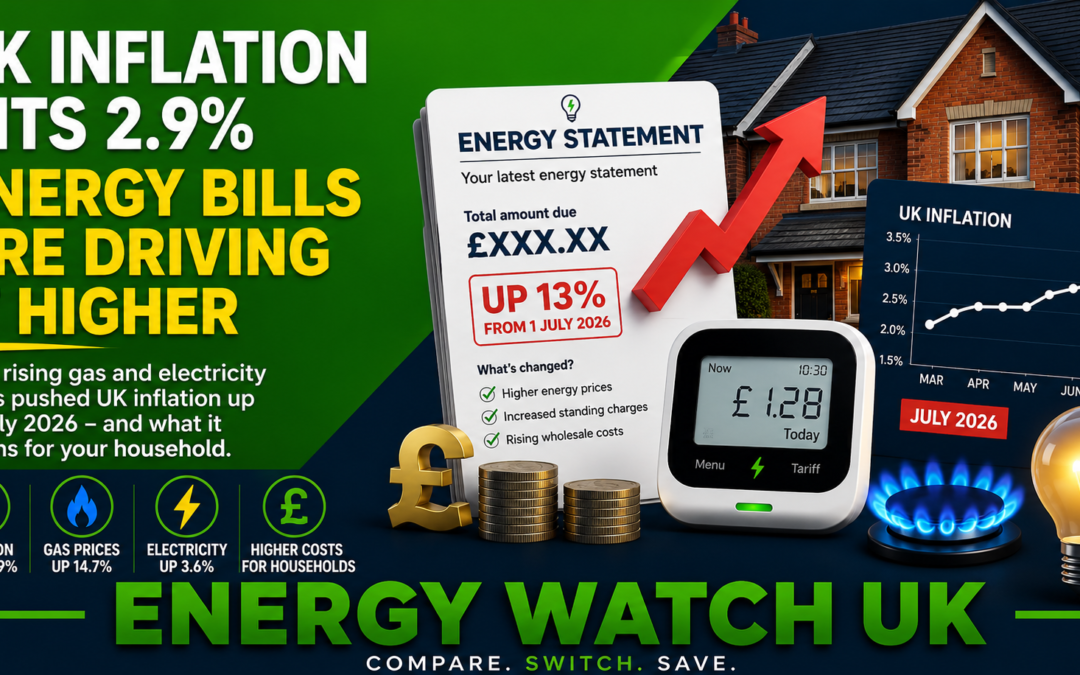
New figures published by the Office for National Statistics show that Consumer Prices Index (CPI) inflation increased to 2.9% in July 2026, up from 2.6% in June.
Importantly for UK households, housing and household services made the largest upward contribution to the increase, particularly gas and electricity.
So why have energy costs increased, what does this mean for household bills, and what should you consider before the next Ofgem energy price cap takes effect?
Energy Watch UK explains.
Why Has UK Inflation Risen to 2.9%?
Inflation measures how quickly the prices of goods and services are increasing.
The latest ONS figures show CPI inflation increased from 2.6% in June to 2.9% in July 2026.
One of the biggest drivers was household energy.
Gas prices rose by 14.7% in July, while electricity prices increased by 3.6%. The ONS says the increase was mainly connected to changes in standard variable tariffs following the July Ofgem energy price cap.
For households already dealing with higher living costs, that makes understanding your current energy tariff increasingly important.
Why Have Gas Prices Increased So Much?
According to the ONS, the 14.7% increase in gas prices during July was the largest monthly increase since October 2022.
The increase was partly caused by the new energy price cap, which itself was affected by higher wholesale energy prices.
Wholesale energy is the gas and electricity suppliers purchase before supplying it to homes and businesses.
When wholesale prices rise significantly, those costs can eventually feed through into household tariffs.
If you’ve noticed your own energy costs increasing recently, read our guide:
Why Has My Energy Bill Gone Up This Month?
What Happened to Electricity Prices?
Electricity prices also increased in July.
ONS figures show electricity prices rose by 3.6% during the month.
Although this increase was considerably smaller than the rise in gas prices, electricity remains a significant household expense.
Your actual costs depend on your tariff, electricity consumption, unit rate and standing charge.
What Is the Current Energy Price Cap?
The current Ofgem energy price cap applies from 1 July until 30 September 2026.
Under Ofgem’s existing typical-consumption measure, the headline figure is £1,862 per year, representing a 13% increase from £1,641. Ofgem also introduced revised Typical Domestic Consumption Values from July, so consumers should focus on their actual unit rates and usage rather than treating a headline annual figure as their personal bill.
For Direct Debit customers on applicable standard variable tariffs, the national average rates from July are:
Electricity: 26.11p per kWh
Electricity standing charge: 57.19p per day
Gas: 7.33p per kWh
Gas standing charge: 29.04p per day
Rates vary according to factors including your region, payment method and meter type.
Does the Energy Price Cap Limit My Total Bill?
No.
This is an important distinction.
The Ofgem energy price cap does not mean your household cannot spend more than the headline annual amount.
Instead, it limits the rates suppliers can charge customers on applicable default tariffs.
Your actual energy bill is largely determined by:
Your energy usage × your unit rate + standing charges
The more gas and electricity you consume, the more you’ll generally pay.
Does Inflation Automatically Make My Energy Bill Rise?
No.
An increase in UK inflation doesn’t automatically cause your energy supplier to increase your bill.
In this case, the relationship largely works in the opposite direction.
Higher gas and electricity prices helped push the overall inflation rate higher.
Your individual energy bill depends more directly on your tariff, consumption, unit rates, standing charges and payment method.
What Happens to Energy Prices in October 2026?
The current energy price-cap period finishes on 30 September 2026.
The next Ofgem price cap will apply from 1 October until 31 December 2026.
Ofgem says the new October rates will be published by 26 August 2026, although they could be published earlier if required.
We’ve covered the upcoming announcement in:
October Energy Price Cap 2026: Latest Forecast and What We Know
This will be one of the most important energy announcements to watch before winter.
Should I Switch Energy Supplier Before October?
You don’t necessarily need to wait until October before comparing energy tariffs.
Comparing doesn’t mean you have to switch.
Instead, it allows you to see how your existing tariff compares with other options currently available.
Check:
- Gas unit rate
- Electricity unit rate
- Gas standing charge
- Electricity standing charge
- Tariff length
- Fixed or variable rates
- Exit fees
- Your annual consumption
For more information, read:
Should I Switch My Energy Supplier Before October 2026?
Should I Fix My Energy Prices?
A fixed energy tariff can provide certainty because your unit rates are normally fixed for an agreed period.
That can be attractive when energy markets are uncertain.
However, fixed doesn’t automatically mean cheaper.
If variable rates subsequently fall, customers on fixed tariffs may not benefit from those reductions.
Some fixed tariffs also have exit fees.
We’ve compared the two options in:
Energy Price Cap or Fixed Tariff: Which Is Cheaper?
Why Your Own Energy Usage Matters
The headline price cap is useful for showing the direction of energy costs, but it isn’t a personalised bill.
Two households on similar tariffs can have very different bills.
Your annual consumption is therefore one of the most important numbers to know.
Check your latest bill for your annual:
Electricity consumption in kWh
and
Gas consumption in kWh
You can then compare tariffs using your own consumption rather than relying solely on an estimated typical household.
Does Where I Live Affect Energy Prices?
Yes.
Energy unit rates and standing charges can vary across Great Britain.
Ofgem explains that regional standing-charge differences are influenced by factors including energy usage and network costs in different areas.
You can find more information about the locations we serve on our Areas We Cover page.
What About the £250 Energy Bill Pylon Discount?
Another energy topic that has attracted attention recently concerns support for eligible households living near new electricity transmission infrastructure.
This is separate from the Ofgem energy price cap and doesn’t mean every household near an existing pylon automatically receives £250.
Read our guide:
Who Qualifies? £250 Energy Bill Pylon Discount
What Should I Check on My Energy Bill?
Get your latest statement and find:
- Electricity unit rate
- Gas unit rate
- Electricity standing charge
- Gas standing charge
- Annual electricity consumption
- Annual gas consumption
- Tariff name
- Tariff end date
- Exit fees
Also check whether your meter readings are actual or estimated.
These figures give you a much clearer picture of what you’re paying and make comparing tariffs considerably easier.
Can I Switch Energy Supplier When Prices Are Rising?
Yes.
Changing market conditions don’t prevent households from comparing or switching energy suppliers.
Different tariffs can have different unit rates, standing charges and contract terms.
Switching supplier doesn’t normally involve changing the physical gas pipes or electricity cables supplying your home.
The key is to compare the complete tariff, rather than simply choosing the lowest advertised monthly Direct Debit.
Compare Energy Suppliers With Energy Watch UK
Today’s inflation figures demonstrate how changes in energy prices can affect household finances and the wider UK economy.
If you haven’t checked your energy tariff recently, now could be a sensible time to understand what you’re paying and compare the options available.
Visit our Home page to find out how Energy Watch UK can help you compare energy suppliers.
You can also learn more About Us, see what customers say on Trustpilot, and find answers to common switching and tariff questions in our FAQs.
Comparing doesn’t mean you have to switch.
It simply gives you the information needed to decide whether staying with your existing tariff or changing could make sense for your household.
Frequently Asked Questions
Why has UK inflation risen to 2.9%?
UK CPI inflation increased from 2.6% in June to 2.9% in July 2026. Housing and household services, particularly gas and electricity, were the largest upward contributor to the change.
How much did gas prices increase in July 2026?
Gas prices increased by 14.7% in July 2026 according to the Office for National Statistics.
How much did electricity prices increase?
Electricity prices increased by 3.6% during July 2026.
Does higher inflation automatically increase my energy bill?
No. Higher inflation doesn’t automatically change your energy tariff. In the latest figures, increased gas and electricity prices were themselves important contributors to rising inflation.
When does the next energy price cap start?
The next Ofgem price-cap period starts on 1 October 2026 and runs until 31 December 2026. Ofgem says the rates will be published by 26 August.
Should I compare energy suppliers now?
You can compare tariffs at any time. Whether switching makes sense depends on your existing tariff, consumption and the alternatives available to you.
Final Thoughts
UK inflation has increased to 2.9%, and today’s official figures show just how significant household gas and electricity prices have become.
But rather than trying to predict exactly what happens next, concentrate on what you can control.
Know your unit rates.
Know your standing charges.
Understand your annual consumption.
Check when your tariff ends.
Then compare your options.
Energy Watch UK helps households understand their energy costs and compare available gas and electricity tariffs.
Author
John — Your Local Energy Watch UK Expert
Helping UK homeowners understand energy prices, compare available gas and electricity tariffs and make informed decisions about their household energy.